GST Number - 07AHIPB1341G1ZW
Choosing the right Hair Comb may appear straightforward, but the material plays a major role in hair care performance, safety, and customer satisfaction. For wholesale buyers and retail procurement teams, material selection is a strategic business decision—not just a matter of design or appearance. Understanding the advantages and limitations of each option helps ensure you stock products that meet market expectations and deliver consistent results. At Bajoria Plast, material quality is treated as a core factor in creating reliable, market-ready hair accessories.
Plastic and metal hair combs cater to different consumer needs and usage scenarios. Selecting the wrong material can negatively impact business outcomes, leading to:
This guide offers a clear comparison of plastic versus metal hair combs from a wholesale sourcing and retail performance standpoint, helping buyers—along with partners like Bajoria Plast—make informed choices that align with their target market and business goals.
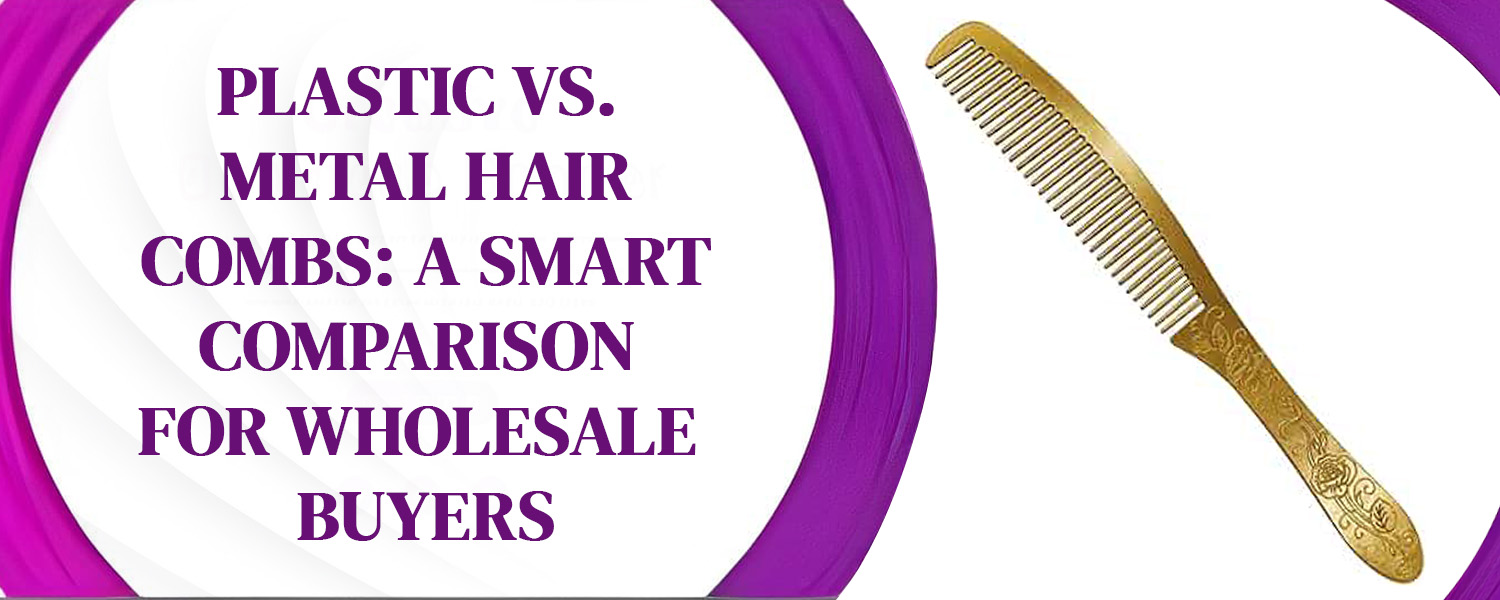
When you place a plastic comb and a metal comb side-by-side, the differences are immediately clear, from feel to function. Each comb material offers distinct advantages and disadvantages that cater to different users, from the everyday person to the professional stylist. For a wholesale buyer, these differences impact everything from cost to marketability. Additionally, metal combs are generally more washable and hygienic than plastic ones, as they can withstand higher temperatures during cleaning and are less likely to harbor bacteria or residue due to their non-porous surfaces.
This table provides a snapshot of the main distinctions. Plastic combs are versatile and consumer-friendly, while metal combs are built for specific, professional tasks. Both types can be safe for everyday hair care when used properly, but plastic combs are generally less likely to cause scalp irritation or hair damage due to their lighter weight and smoother edges. Metal combs may be preferable for certain hair types but can be harsh if not used with care. Understanding these core attributes is the first step in making a smart purchasing decision.
|
Factor |
Plastic Hair Combs |
Metal Hair Combs |
|
Unit Cost |
Low to moderate pricing |
Generally higher cost |
|
MOQ Flexibility |
Highly flexible for bulk and small orders |
Often requires larger minimum orders |
|
Weight |
Lightweight and easy to handle |
Heavier in comparison |
|
Durability |
Strong and impact-resistant |
Durable but may bend under pressure |
|
Hair Safety |
Smooth and gentle on the scalp |
Higher chance of hair pulling or snagging |
|
Customization Options |
Wide range of colors, branding, and designs |
Limited customization possibilities |
|
Best-Suited Channels |
Retail stores, supermarkets, salons |
Professional barber and grooming use |
|
Factor |
Plastic Hair Combs |
Metal Hair Combs |
Looking for a reliable hair comb manufacturer?
Get material advice and wholesale pricing from our factory.
Plastic Hair Combs: The Retail & Wholesale Essential
Step into any retail store, and plastic hair combs are everywhere—they are the clear standard across both retail and wholesale markets. Their affordable pricing makes them accessible to all consumers, which is why they remain a basic household item for everyday hair care. Compared to metal combs, plastic options are generally more comfortable to use, especially in hair accessories or daily grooming, thanks to their lightweight feel and smooth edges that help reduce scalp irritation.
For wholesale buyers, this mass appeal translates into a dependable, fast-moving product. Plastic hair combs can be sourced in bulk at low cost and sold to a wide customer base with minimal risk. Below, we explore why plastic combs dominate the market and the materials commonly used to manufacture them.
Plastic hair combs continue to dominate due to a combination of affordability, versatility, and ease of use. Their low production cost makes them an impulse-friendly purchase for consumers and a high-turnover product for wholesalers.
Another key advantage is versatility. Plastic combs are suitable for detangling, everyday styling, and general hair management across most hair types. They move smoothly through hair, helping distribute natural oils from the scalp to the ends without requiring special skills.
Their widespread popularity is driven by three major factors:
Although commonly grouped under the term “plastic,” hair combs are made from different polymers, each offering unique benefits.
Professional manufacturers typically use:
These materials share several practical advantages:
Metal hair combs are not designed for everyday consumer use. Instead, they serve as precision tools for professionals who require strength, heat resistance, and styling accuracy. Their firm metal teeth allow stylists to perform tasks that plastic combs cannot handle effectively.
These combs are particularly valued for creating sleek, polished styles and are often used alongside professional heat tools. However, their specialized nature limits their appeal in mainstream retail and wholesale environments.
Metal combs are most effective in professional salon settings. One of their greatest strengths is heat resistance, making them ideal for use with straighteners and curling irons without the risk of melting or warping.
They are commonly used for:
Their durability and performance make them a favorite among trained professionals.
Despite their professional benefits, metal hair combs pose challenges for mass retail and wholesale distribution. Their higher production cost leads to higher retail prices, which limits demand among everyday consumers.
Safety is another concern. Without proper technique, rigid metal teeth can irritate or scratch the scalp, increasing the risk of discomfort or minor injury. For most consumers, plastic combs are a far safer and more user-friendly option.
Because of these factors, wholesalers and retailers are better served by focusing on consumer-safe, versatile products. Plastic hair combs meet the needs of a broader audience, making them the smarter choice for scalable, reliable inventory.
When a customer chooses a comb, they are looking for something that works well and feels good to use. The difference in user experience between plastic and metal is stark, primarily due to safety. A poorly used comb can lead to scalp irritation, hair damage, and broken hair strands.
For wholesale buyers, understanding this difference is critical for customer satisfaction and brand reputation. Let's break down why plastic combs are designed to be consumer-friendly, while metal combs are best left to those with professional skills.
Plastic combs are intentionally designed for the average person. Their teeth are typically more flexible and have smoother, rounded tips. This design minimizes the risk of scratching the scalp or snagging and breaking hair strands during detangling.
This user-friendly nature makes them ideal for everyday tasks like smoothing hair and taming flyaways. They glide through the hair gently, helping to achieve a polished look without causing damage. This contributes to overall hair health by reducing mechanical stress on the hair.
When considering hair loss, does a plastic comb help? By being gentle, it can prevent the breakage and pulling that exacerbate hair loss.
- They are lightweight and easy to handle.
- The flexible teeth can move around tangles rather than ripping through them.
- They are a safe tool for maintaining healthy hair with minimal risk.
Using a metal comb effectively and safely requires a trained hand. While they are great for scalp stimulation when used correctly, the same rigid metal teeth can easily cause discomfort or damage if too much pressure is applied. This can irritate hair follicles and lead to bigger problems.
Can a metal comb help reduce static? Yes, this is one of its key advantages. Metal is conductive, which helps to neutralize the electrical charge in hair that causes static and flyaways, resulting in a smoother finish than many plastic combs can offer.
However, this benefit doesn't outweigh the risks for an everyday user. The potential for scraping the scalp or pulling hair is a significant drawback. This is why the metal comb remains a tool for professionals who understand the right amount of pressure and technique to use.
For wholesale buyers looking to build a brand, customization is everything. The ability to add your logo, choose specific colors, and create unique designs offers significant branding flexibility. The material of the comb plays a huge role in how easily this can be achieved.
Different materials offer different levels of adaptability for private labeling. As we'll see, plastic provides a nearly blank canvas for your branding ideas, while metal presents more significant limitations.
If you're looking to create a private-label hair tool, plastic is your best option. The injection molding process used to create a plastic comb makes customization simple and cost-effective. You can create a comb in virtually any color to match your brand's aesthetic.
This branding flexibility extends to the design itself. You can easily create unique shapes, add ergonomic grips, or develop specialized tooth patterns for different hair types. A plastic comb can be an effective tool that is also a strong representation of your brand identity.
Here’s why plastic is superior for branding:
- Color Matching: Easily produce combs in specific Pantone colors.
- Logo Embossing: Adding your brand name or logo directly into the mold is simple.
- Custom Shapes: Design a unique product that stands out on the shelf.
- Low Minimum Orders: Customization is often available even for smaller wholesale orders.
Customizing a Wooden comb is a much more challenging and expensive endeavor. The materials and manufacturing processes are not easily adapted for cosmetic changes. Engraving a logo is possible, but it adds significant cost per unit.
Creating custom shapes or colors is often prohibitively expensive, requiring new molds and specialized tooling. This makes it difficult for wholesalers to develop a unique private-label metal comb without a massive financial investment. The options are generally limited to what manufacturers already produce.
For businesses focused on building a brand with a curated selection of the finest hair care products, these limitations are a major drawback. The inability to easily customize a metal comb means you are simply reselling a generic product with little to no unique brand identity.
For wholesale buyers, every purchasing decision ultimately comes down to profitability. Product cost directly affects margins, cash flow, and long-term business growth. When comparing plastic and metal hair combs, the difference in financial performance is clear. Plastic combs are built for volume-driven sales and mass-market accessibility, making them a more practical option for most wholesale businesses.
Their low manufacturing cost supports competitive pricing, faster sales cycles, and consistent margins. Metal combs, by contrast, serve a smaller, more specialized audience and follow a premium, lower-volume sales model. Below is a closer look at why plastic combs often deliver stronger returns.
From a business standpoint, plastic hair combs offer a highly reliable revenue model. They can be sourced in bulk at a very low per-unit cost, allowing wholesalers to price competitively while still maintaining healthy margins. Even at affordable retail prices, strong demand ensures steady profitability.
Because plastic combs are a daily-use grooming essential, demand remains consistent across seasons and markets. This results in quick inventory turnover, freeing up capital and reducing storage risk. It’s a proven high-volume, low-risk approach that works well for both new and established buyers.
Key financial advantages include:
Every market has unique needs. That’s why our team assists buyers in selecting the right comb material, packaging style, and MOQ based on their specific sales channel.
Metal hair combs are generally positioned as professional or specialty tools, which results in a higher production and purchase cost. Their metal construction offers durability, heat resistance, and styling precision—qualities that appeal mainly to trained professionals.
While metal combs provide benefits such as scalp stimulation, improved blood circulation, and precise styling control, their higher retail price limits mass-market appeal. As a result, sales volumes tend to be lower, making them less suitable for buyers focused on rapid turnover and cost efficiency.
For wholesalers prioritizing scalability and consistent demand, the slower movement of metal combs may not align with overall business goals.
Based on cost, demand, and scalability, the choice becomes straightforward.
Choose Plastic Hair Combs if you:
✔ Supply supermarkets, discount stores, or online marketplaces
✔ Require private label or branded customization
✔ Focus on repeat orders and scalable supply
✔ Target everyday consumers
Choose Metal Hair Combs if you:
✔ Serve professional barbers or salon stylists
✔ Offer niche or specialized grooming tools
✔ Are comfortable with lower volume and higher unit pricing
Selecting the right supplier is just as important as choosing the right product. At Bajoria Plast, we specialize in high-quality plastic hair combs designed for durability, safety, and everyday performance. Our products are suitable for all hair types and crafted to meet both professional and consumer expectations.
By stocking the Bajoria Plast plastic comb range, wholesale buyers gain access to reliable, fast-moving products that customers trust and repurchase. With a strong focus on quality, variety, and market understanding, we help buyers build a competitive hair care assortment that drives long-term growth and profitability.
Looking for plastic hair combs for wholesale or private label projects?
Need a reliable manufacturer for long-term supply?
Contact Bajoria Plast today to receive:
- Wholesale pricing & MOQ details
- Material and packaging recommendations
- Free sample consultation
Start your sourcing with a professional comb manufacturer.
Plastic combs are generally more effective at minimizing hair loss caused by breakage. Their smooth, flexible teeth glide through hair more easily, reducing pulling and stress on the hair follicles. While metal combs may stimulate blood circulation, improper or frequent use can lead to scalp irritation and increased hair damage.
Not necessarily. Although metal combs can help spread natural oils and stimulate the scalp, they carry a higher risk of scratching the scalp or snagging hair if not used correctly. For daily grooming and overall hair health, a well-made plastic comb is usually the safer and more practical option.
A wide-tooth plastic comb is typically the best choice for thick or curly hair. The wider gaps and flexible structure allow knots to be gently separated without pulling or breakage. Metal combs tend to be more rigid, which can make detangling harder and increase the risk of hair damage.